


1. Introduction
2. Methods
Field study
Fisher interviews
Data analysis
3. Results
Seabird bycatch status
Fisher interviews
4. Discussion
1. Introduction
Marine animals have long maintained close relationships with humans. Humans share marine resources with seabirds (Furness and Monaghan 1987) and have utilized seabird foraging activity to locate fish schools (Hall and Roman 2013; Le Bot et al. 2018). However, the interaction between fisheries and marine wildlife has intensified, leading to the issue of bycatch.
Bycatch refers to incidental capture of non-target species during fishing including cetaceans, sea turtles, and seabirds. Bycatch is recognized globally as a critical threat to seabird survival globally (Croxall et al. 2012; Dias et al. 2019). Recent studies estimate that at least 764,000 seabirds die annually due to bycatch (data from Anderson et al. 2011, Žydelis et al. 2013 and Phillips et al 2024). This mortality is particularly concerning for seabirds, which are characterized by low reproductive rates and delayed maturity. Thus, bycatch-induced mortality can severely impact the maintenance of breeding populations (Dias et al. 2019; Munilla et al. 2007). In South Korea, while data on cetacean and sea turtle bycatch have been collected (Jung et al. 2012; Kim et al. 2013; Lee et al. 2018; Moon et al. 2009), seabird bycatch data remain limited to specific regions (KOEM 2018; Park et al. 2012). The East Sea coast is a critical wintering ground that hosts over 100,000 seabirds annually (NIBR 2019–2024). However, recent comprehensive assessments of seabird bycatch are rarely conducted (Park et al. 2012; Choi and Nam 2017; KOEM 2018). Especially, seabird bycatch in small-scale fisheries of the northeast coast of South Korea is difficult to monitor systematically and is likely to be significantly underreported. Present study aimed to investigate the status and characteristics of seabird bycatch along the northeast coast of South Korea. Based on periodic field surveys and interviews conducted with local fishers conducted from 2019 to 2024, we analyzed species composition, temporal patterns and the types of fisheries involved, with the goal of providing baseline data for effective conservation and management strategies.
2. Methods
Field study
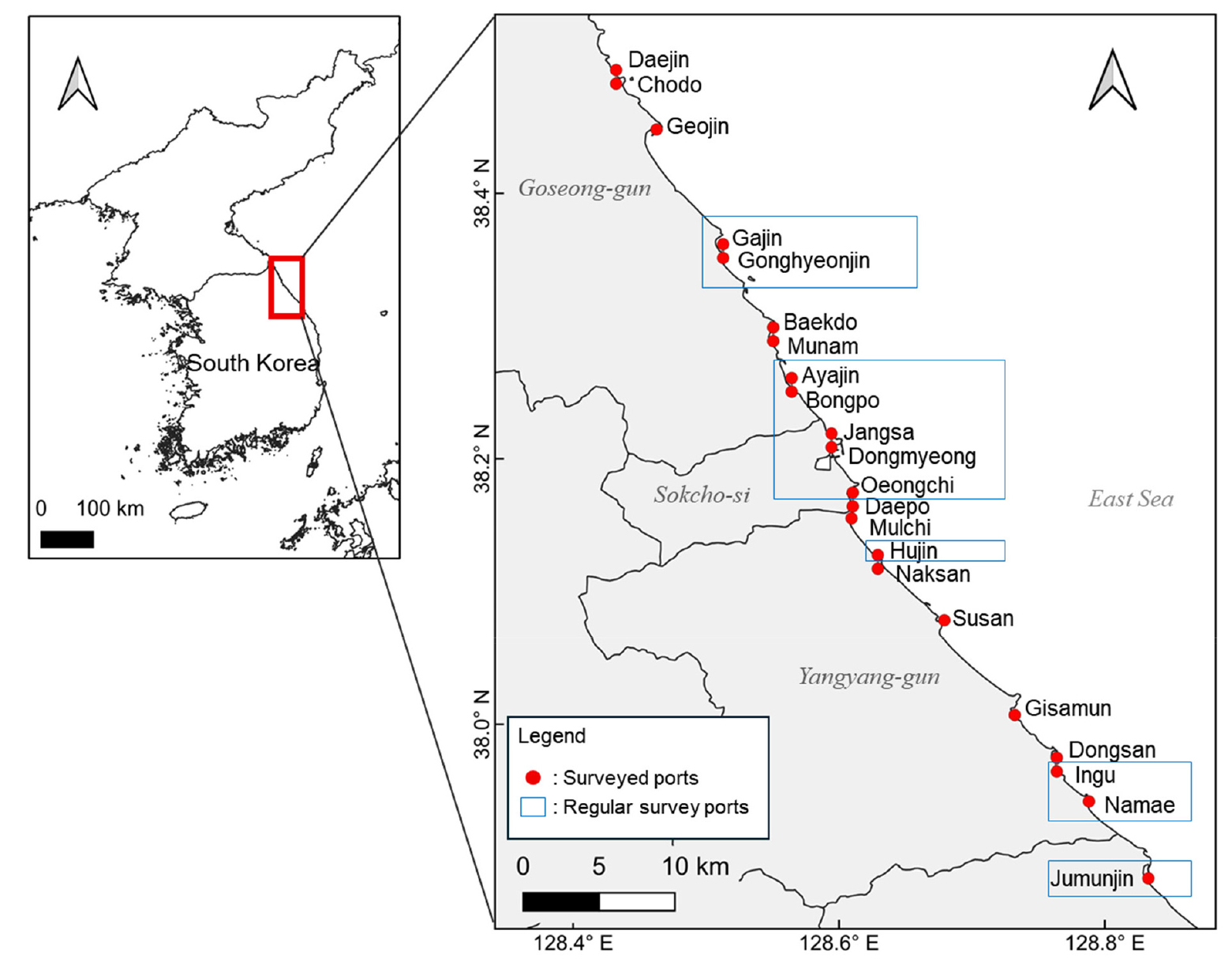
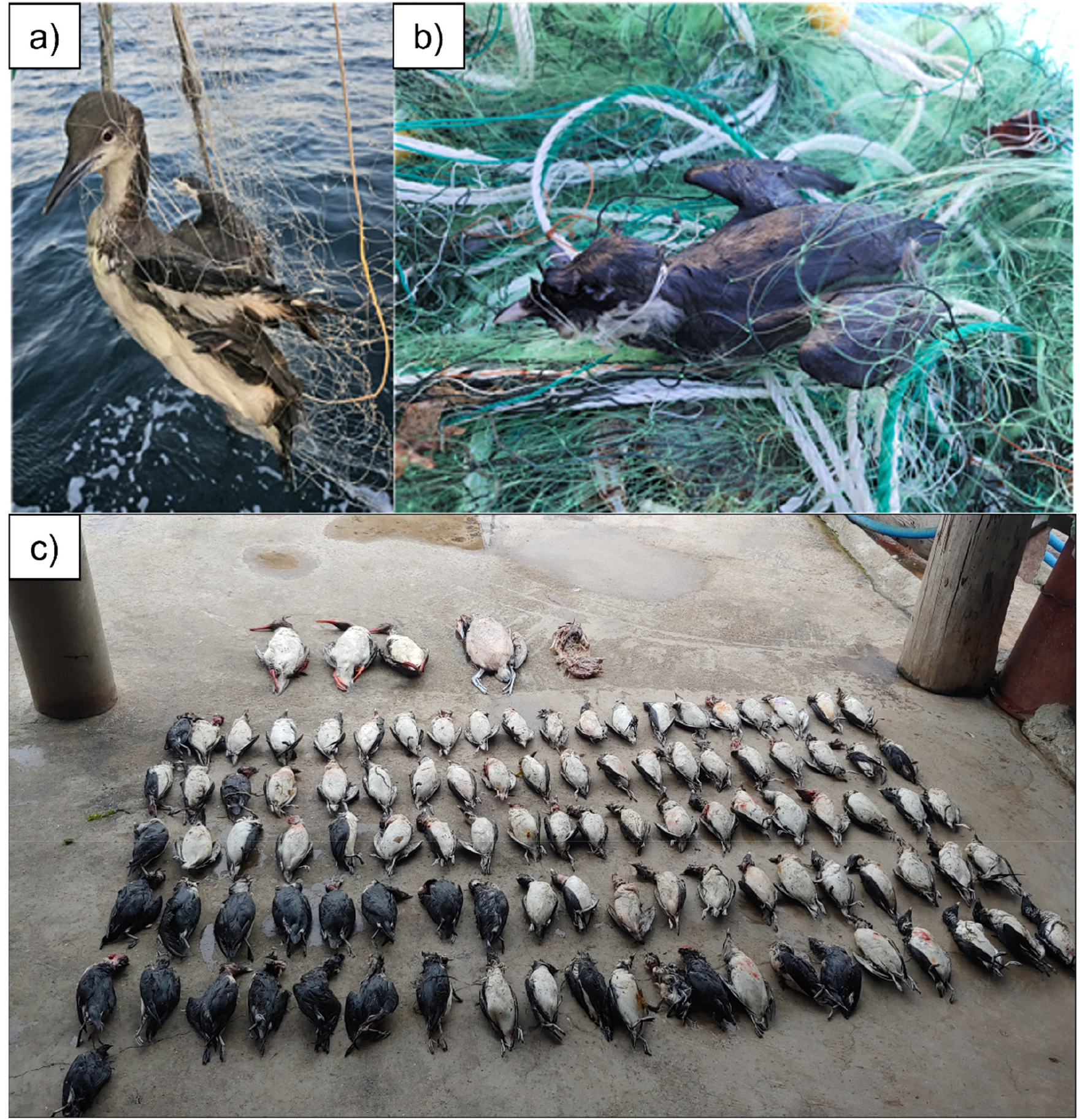
Field studies were categorized into regular surveys and opportunistic surveys. Regular surveys were conducted at fixed intervals (January to April: twice a month and May to October: once a month) to identify the seasonal occurrence of seabird bycatch over a year (February 2022 to January 2023) at 11 ports in Goseong, Sokcho, Yangyang, and Gangneung (Fig. 1). During these visits, the presence of seabird carcasses at ports was recorded (Fig. 2). We also investigated whether any seabird carcasses had been disposed of in dumpsters or bins at ports. Seabird carcasses attributed to bycatch frequently showed net-inflicted injuries on the neck, face and wings. In contrast, opportunistic surveys were conducted from 2019 to 2024, excluding the regular survey period at a total of 22 ports. We visited fishery ports when seabirds were incidentally caught by fishers during their fishing activities. Supplementary information was also obtained from fishers and NGOs. In total, 56 cases involving 264 carcasses were recorded during opportunistic surveys (15 cases in 2019; 2 cases in 2020; 3 cases in 2021; 29 cases in 2023; and 7 cases in 2024). The feeding behavior of bycaught species was determined based on published references (Park 2022).
Fisher interviews
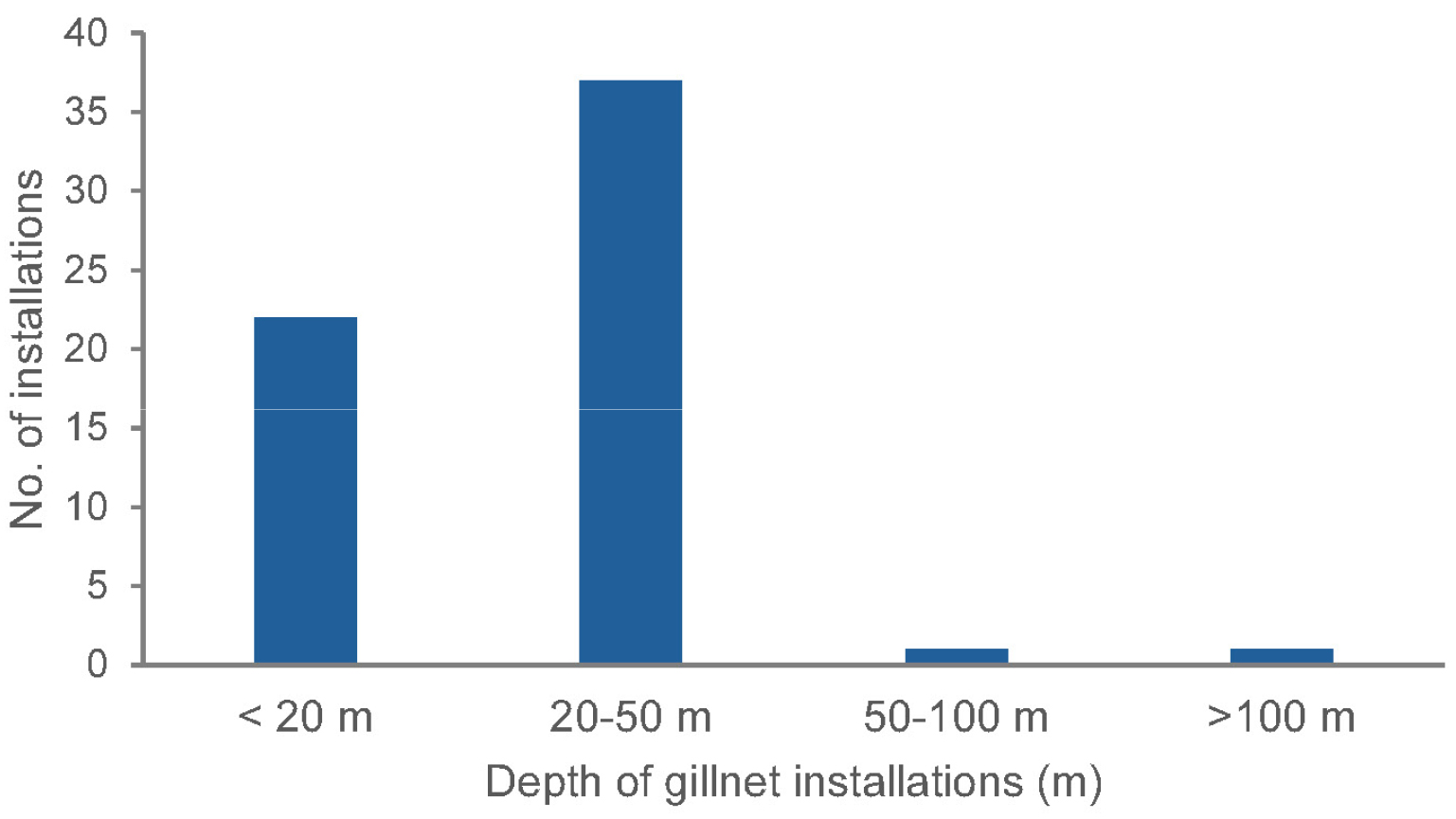
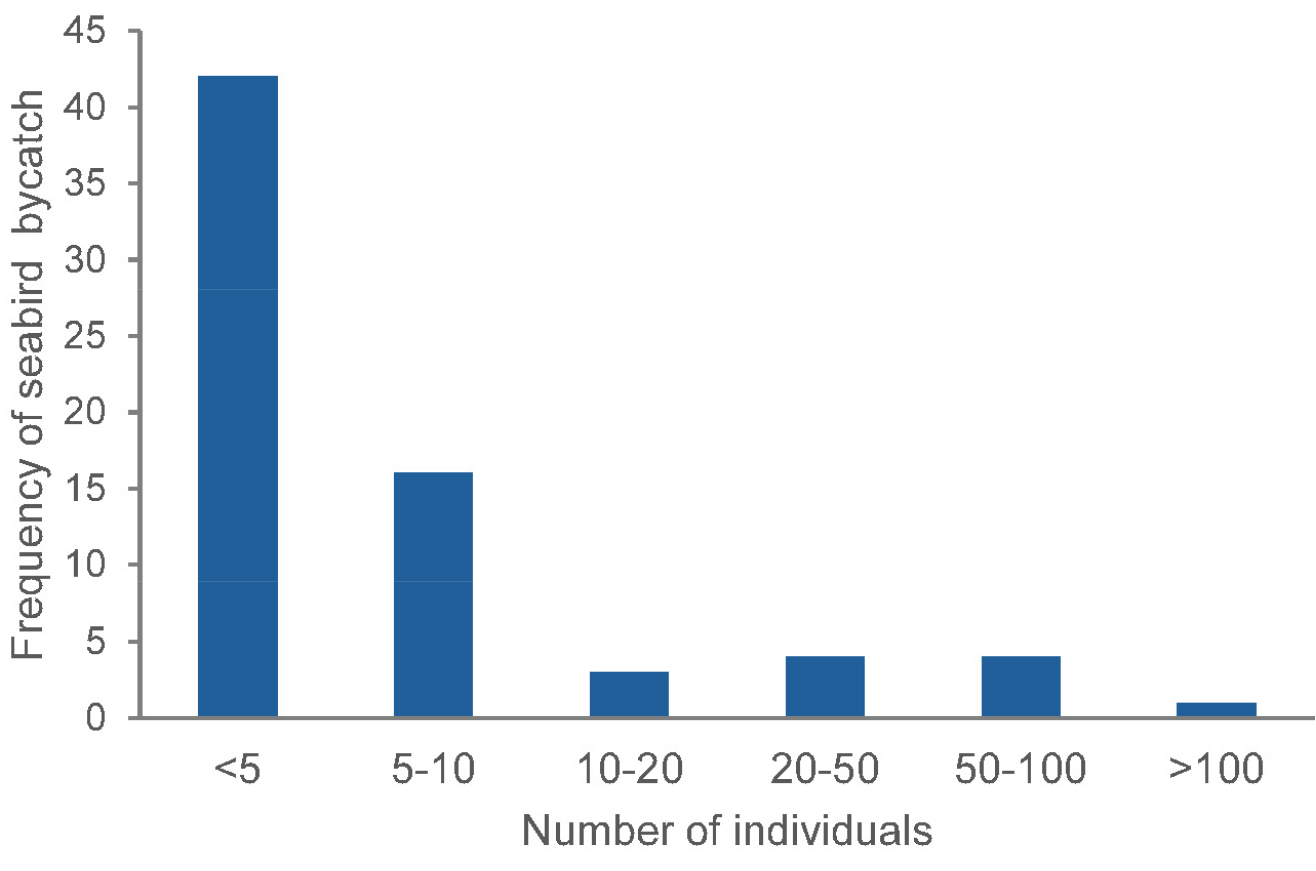
Interviews with fishers were conducted monthly from February 2022 to January 2023 at 11 ports at the same day as the field survey. Data were collected from 59 fishers who had previously experienced seabird bycatch (Supplement Table S1). The interviews focused on the timing of bycatch events and specific fishing methods, including gear types (e.g. angling, purse seine, gillnet, or trawl) and the depth of gillnet installation (< 20 m, 20–50 m, 50–100 m, and > 100 m). Fishers were allowed to select multiple answers for the months of seabird bycatch and the number of seabirds caught per incident.
Data analysis
Species composition and mortality counts were summarized, with a particular focus on identifying legally protected species. We assessed whether the bycaught seabird species were designated as Marine Protected Species by the Ministry of Oceans and Fisheries (MOF), listed as Endangered Wildlife Species by the Ministry of Climate, Energy, Environment (MCEE), or included on the IUCN Red List. To assess the seasonal occurrence of seabird bycatch, only data from the regular surveys were used. Opportunistic survey data were excluded because they were largely based on reported incidents and may have been biased in terms of survey timing and spatial coverage. To compare the monthly occurrence of seabird bycatch between the non-wintering (May–October) and wintering (November–April) periods, a Mann-Whitney U-test was performed. All statistical analyses were performed using IBM SPSS Statistics.
3. Results
Seabird bycatch status
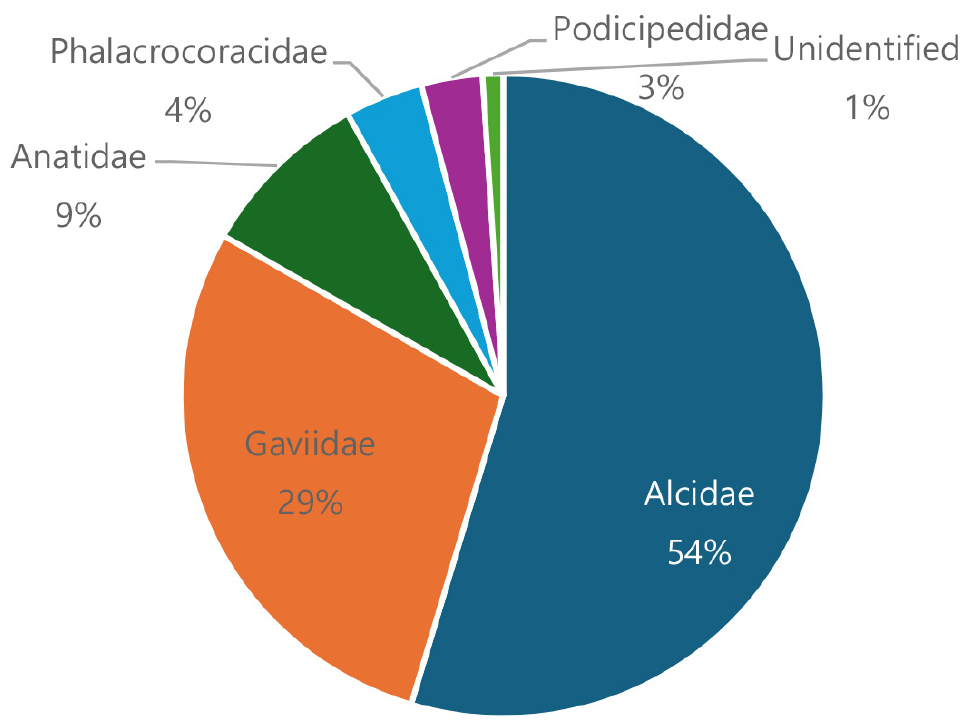
A total of 586 individuals representing 16 species were recorded as bycatch in the northeast coast of South Korea based on data from regular (15 species of 375 birds) and opportunistic surveys (9 species of 211 birds) (Table 1). The Ancient Murrelet (Synthliboramphus antiquus) was the most frequently bycaught species (n = 289), followed by the Pacific Loon (Gavia pacifica, n = 84), Red-breasted Merganser (Mergus serrator, n = 50), Black-throated Loon (Gavia arctica, n = 31), Rhinoceros Auklet (Cerorhinca monocerata, n = 24), Pelagic Cormorant (Urile pelagicus, n = 20), Great Crested Grebe (Podiceps cristatus, n = 17), Red-throated Loon (Gavia stellata, n = 5), Thick-billed Murre (Uria lomvia, n = 3) and Long-billed Murrelet (Brachyramphus perdix, n = 2). The Yellow-billed Loon (G. adamsii), Red-necked Grebe (P. grisegena), Japanese Cormorant (Phalacrocorax capillatus), Spectacled Guillemot (Cepphus carbo) and Japanese Murrelet (S. wumizusume) were each recorded only once. Notably, a mass bycatch event involving 105 Ancient Murrelets in a single fishing operation was documented at Gajin Port on March 15 in 2019. By family, Alcidae accounted for 54% of the total bycatch (n = 320), Gaviidae 29% (n = 168), Anatidae 9% (n = 51), Phalacrocoracidae 4% (n = 23), and Podicipedidae 3% (n = 18) (Fig. 3). Although opportunistic surveys covered more years and a larger number of ports, more seabird species and individuals were recorded as bycatch during the regular surveys.
Table 1.
Status of seabird bycatch recorded through field surveys on the northeast coast of South Korea from 2019 to 2024
| Species/ or group | Scientific name | No. of individuals |
Feeding behavior | ||||||
| 2019 | 2020 | 2021 | 2022* | 2023* | 2024 | Total | |||
| Stejneger’s Scoter | Melanitta stejnegeri | 0 | 0 | 0 | 0 | 1 | 0 | 1 | Diving |
| Red-breasted Merganser | Mergus serrator | 6 | 0 | 0 | 28 | 15 | 1 | 50 | Diving |
| Red-throated Loona) | Gavia stellata | 3 | 0 | 0 | 1 | 0 | 1 | 5 | Diving |
| Black-throated Loon | Gavia arctica | 2 | 0 | 1 | 14 | 11 | 3 | 31 | Diving |
| Pacific Loon | Gavia pacifica | 17 | 0 | 3 | 40 | 20 | 4 | 84 | Diving |
| Yellow-billed Loond) | Gavia adamsii | 0 | 0 | 0 | 0 | 1 | 0 | 1 | Diving |
| Red-necked Grebe | Podiceps grisegena | 0 | 0 | 0 | 0 | 0 | 1 | 1 | Diving |
| Great Crested Grebe | Podiceps cristatus | 2 | 0 | 1 | 4 | 10 | 0 | 17 | Diving |
| Japanese Cormorant | Phalacrocorax capillatus | 0 | 0 | 0 | 1 | 0 | 0 | 1 | Diving |
| Pelagic Cormoranta) | Urile pelagicus | 0 | 2 | 0 | 7 | 11 | 0 | 20 | Diving |
| Thick-billed Murre | Uria lomvia | 0 | 0 | 0 | 1 | 2 | 0 | 3 | Diving |
| Spectacled Guillemot | Cepphus carbo | 0 | 0 | 0 | 0 | 1 | 0 | 1 | Diving |
| Long-billed Murreletd) | Brachyramphus perdix | 0 | 0 | 0 | 1 | 1 | 0 | 2 | Diving |
| Ancient Murreleta) | Synthliboramphus antiquus | 113 | 0 | 2 | 119 | 25 | 30 | 289 | Diving |
| Japanese Murreleta),b),c) | Synthliboramphus wumizusume | 0 | 0 | 0 | 0 | 1 | 0 | 1 | Diving |
| Rhinoceros Aukleta) | Cerorhinca monocerata | 12 | 0 | 0 | 1 | 11 | 0 | 24 | Diving |
| Unidentified loons | - | 5 | 0 | 0 | 13 | 27 | 2 | 47 | - |
| Unidentified cormorants | - | 0 | 0 | 0 | 0 | 2 | 0 | 2 | - |
| Unidentified species | - | 0 | 0 | 0 | 1 | 5 | 0 | 6 | - |
| No. of species | - | 7 | 1 | 4 | 11 | 13 | 6 | 16 | |
| No. of individuals | - | 160 | 2 | 7 | 231 | 144 | 42 | 586 | |
A total of five marine protected species designated by the Ministry of Oceans and Fisheries (MOF) were identified such as Red-throated Loons (n = 5), Pelagic Cormorants (n = 20), Ancient Murrelets (n = 289), a Japanese Murrelet (n = 1), and Rhinoceros Auklets (n = 24). The Japanese Murrelet is also designated as Class II Endangered Wildlife species by the Ministry of Climate, Energy, Environment (MCEE) and is listed as Vulnerable (VU) on the IUCN Red List. Additionally, Yellow-billed Loon (n = 1) and Long-billed Murrelet (n = 2) are classified as Near Threatened (NT) on the IUCN Red List.
Regular surveys revealed that bycatch occurred primarily during the wintering period (November–April) (Table 2; Fig. 4). There was a highly significant difference between wintering and non-wintering period (Mann-Whitney U- test, U = 0.0, p < 0.01). No carcasses were observed from May to October which coincide with the period after winter birds have migrated. Fisher interviews supported these findings, with respondents confirming that bycatch mainly occurs from November to April (Fig. 4).
Table 2.
Monthly status of seabird bycatch during regular surveys on the northeast coast of South Korea (February 2022–January 2023)
| Species/ or group | Scientific name | No. of individuals | |||||||||||
| Jan | Feb | Mar | Apr | May | Jun | Jul | Aug | Sep | Oct | Nov | Dec | ||
| Red-breasted merganser | Mergus serrator | 0 | 0 | 1 | 27 | 0 | 0 | 0 | 0 | 0 | 0 | 0 | 0 |
| Red-throated loona) | Gavia stellata | 0 | 0 | 0 | 1 | 0 | 0 | 0 | 0 | 0 | 0 | 0 | 0 |
| Black-throated loon | Gavia arctica | 4 | 2 | 1 | 10 | 0 | 0 | 0 | 0 | 0 | 0 | 0 | 1 |
| Pacific loon | Gavia pacifica | 6 | 0 | 3 | 37 | 0 | 0 | 0 | 0 | 0 | 0 | 0 | 0 |
| Yellow-billed loon | Gavia adamsii | 1 | 0 | 0 | 0 | 0 | 0 | 0 | 0 | 0 | 0 | 0 | 0 |
| Great crested grebe | Podiceps cristatus | 0 | 1 | 2 | 1 | 0 | 0 | 0 | 0 | 0 | 0 | 0 | 0 |
| Japanese cormorant | Phalacrocorax capillatus | 0 | 1 | 0 | 0 | 0 | 0 | 0 | 0 | 0 | 0 | 0 | 0 |
| Pelagic cormoranta) | Urile pelagicus | 1 | 0 | 1 | 0 | 0 | 0 | 0 | 0 | 0 | 0 | 6 | 0 |
| Thick-billed murre | Uria lomvia | 1 | 1 | 0 | 0 | 0 | 0 | 0 | 0 | 0 | 0 | 0 | 0 |
| Spectacled guillemot | Cepphus carbo | 1 | 0 | 0 | 0 | 0 | 0 | 0 | 0 | 0 | 0 | 0 | 0 |
| Long-billed murrelet | Brachyramphus perdix | 1 | 1 | 0 | 0 | 0 | 0 | 0 | 0 | 0 | 0 | 0 | 0 |
| Ancient murreleta) | Synthliboramphus antiquus | 25 | 1 | 0 | 3 | 0 | 0 | 0 | 0 | 0 | 0 | 0 | 115 |
| Rhinoceros aukleta) | Cerorhinca monocerata | 10 | 0 | 0 | 0 | 0 | 0 | 0 | 0 | 0 | 0 | 0 | 1 |
| Unidentified loons | - | 3 | 0 | 0 | 13 | 0 | 0 | 0 | 0 | 0 | 0 | 0 | 0 |
| Unidentified species | - | 0 | 0 | 0 | 1 | 0 | 0 | 0 | 0 | 0 | 0 | 0 | 0 |
| No. of species | - | 9 | 6 | 5 | 6 | 0 | 0 | 0 | 0 | 0 | 0 | 1 | 3 |
| No. of individuals | - | 53 | 7 | 8 | 93 | 0 | 0 | 0 | 0 | 0 | 0 | 6 | 117 |
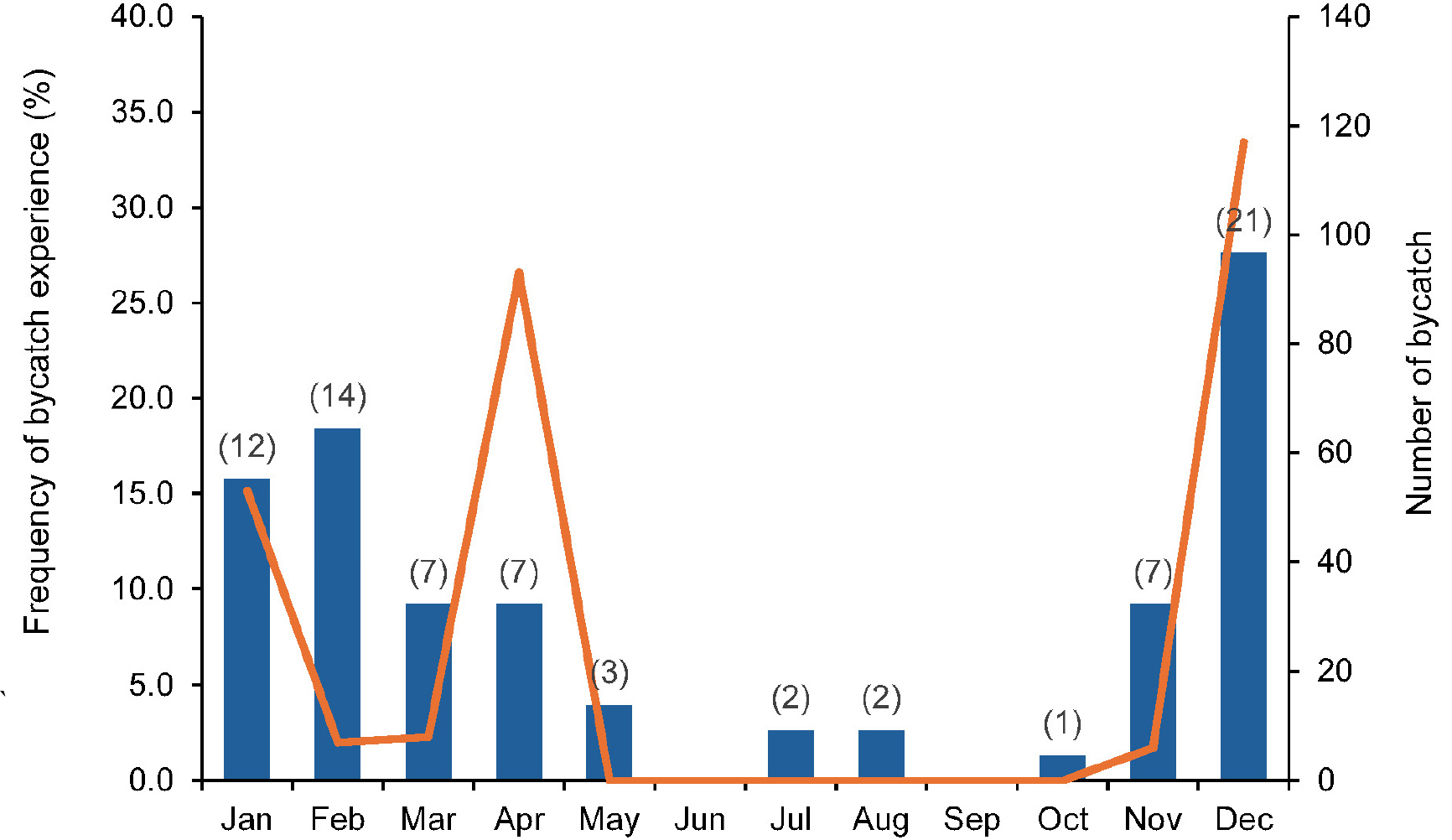
Fig. 4.
Fig. 4. Seasonal distribution of seabird bycatch: comparison between the number of bycatch experiences reported by fishers (n = 59, left axis, bar) and the number of individuals identified during regular surveys (right axis; line). Numbers in parentheses above the bars indicate the numbers of fishers who reported seabird bycatch experience for each month. Fishers selected multiple responses regarding the months when seabird bycatch occurred and the number of seabirds caught in a single operation
Fisher interviews
All 59 fishers who reported experiencing bycatch indicated that these incidents occurred exclusively in gillnet fisheries. The installation depths for these nets were consistently shallower than 50 m. Specifically, 35.6% of the incidents occurred at depths of less than 20 m, and 61.0% were reported at depths between 20 m and 50 m (Fig. 5). According to the interviews, approximately half of respondents engaged in fishing activities for more than 20 days per month (Table 3). They also noted that fewer than five seabirds are incidentally captured per fishing operation although a fisher had experiences of incidental catch more than 100 seabirds at a single installation (Fig. 6).
4. Discussion
This study recorded 16 seabird species affected by bycatch in the northeast coast of South Korea (Table 1). Notably, one-third of the 14 Marine Protected Species (birds) designated by the MOF are suffering mortality from fishing activities (Table 1). One Japanese Murrelet, categorized as VU on the IUCN Red List (BirdLife International 2018), was recorded as bycatch. These findings highlight the conservation importance of bycatch in the northeast coast of South Korea and suggest that it may represent an underrecognized threat to seabird species of high conservation concern.
Most seabirds found dead during regular and opportunistic surveys were species that forage by diving underwater such as a scoter, mergansers, loons, grebes, cormorants, murres, a guillemot, murrelets and auklets (Table 1). Guillemots and loons were also reported as vulnerable species to gillnet bycatch in other studies (e.g. Žydelis et al. 2013). It is inferred that these diving seabirds drown after becoming entangled in nets while pursuing prey that is either trapped in or moving toward the fishing gear. Seabird species vulnerable to bycatch vary depending on fishing methods (Dias et al. 2019). Diving seabirds are known to be particularly susceptible to gillnet fisheries (Žydelis et al. 2013). In the present survey, all fishers who reported bycatch incidents were using gillnets. Gillnet fisheries are considered one of the most significant sources of mortality affecting seabird populations worldwide. At least 400,000 seabirds are estimated to be killed annually by gillnet bycatch (Žydelis et al. 2013) compared with approximately 320,000 birds per year in longline fisheries (Anderson et al. 2011). Because gillnet fisheries dominate in the study area (MOF 2024), seabird bycatch in other fishery types warrants further assessment in Korea.
Seabird bycatch occurred exclusively during the winter season (Table 2; Fig. 4), which coincides with higher fishery yields (KOEM 2018) and increased seabird abundance (NIBR 2019; 2020; 2021; 2022; 2023; 2024) in Gangwon State. The spatial- temporal overlap between primary fishing areas and seabird foraging grounds leads to the frequent occurrence of bycatch incidents. Park et al. (2012) suggested that fish stock distribution may be related to seabird bycatch. Distribution of seabirds is often affected by movement of prey during post-breeding period (Jessopp et al. 2013; Amélineau et al. 2018). Consequently, seabird vulnerability to bycatch is influenced by both ecological traits and fishing activities. Fishers suggested that seabird bycatch also occurred during summer, although no carcasses were found from May to September during the regular surveys. Although no seabird bycatch was detected during field surveys, additional seabird bycatch is likely to occur. Further studies are required to confirm this.
Among the seabirds recorded as bycatch, the Ancient Murrelet was the most frequently recorded, consistent with the findings of Park et al. (2012). Present study confirmed the mass mortality of over 100 Ancient Murrelets at a single port in December (Fig. 2). It was also reported in the fisher interviews that one respondent accidentally caught more than 100 birds in a single set (Fig. 6). Majority of fishers stated that these gillnets were set at depths of less than 20 m or between 20 and 50 m (Fig. 6). Generally, the Ancient Murrelet has an average diving depth of 9.4 m and a maximum average diving depth of approximately 24.4 m (Elliott et al. 2010). This foraging range overlaps with the operational depths of local gillnet fisheries. However, seabirds may also be caught in gillnets set deeper than their maximum diving depth when they are entangled during net setting or hauling operation (Løkkeborg 2008). Wintering period can be a main factor affecting bycatch. East Coast of Korea is one of the wintering sites of Ancient Murrelets which migrate from British Columbia (BC) in Canada to East Asia across the pacific after breeding (Gaston et al. 2017). They migrate to Korea in October–November and return to BC in February and March. Ultimately, the combination of the Ancient Murrelet's diving foraging behavior and the structural characteristics of gillnet fisheries result in frequent mass bycatch events.
Bycatch can induce long-term population declines of seabirds (Phillips et al. 2016). Seabirds take a long time to breed and have low fecundity compared to terrestrial birds. Massive mortality can easily induce global population decline because it takes a long time to recover. Furthermore, detecting and confirming seabird bycatch in the small-scale fisheries prevalent along the northeast coast of South Korea is inherently difficult. 375 bycaught seabirds confirmed in regular surveys for a year represent only the minimum observed counts and likely underestimate the actual annual bycatch volume. If we assume a conservative rate where 998 gillnet vessels (MOF 2024) catch just one bird per ten operations, the total winter mortality could easily exceed 10,000 individuals. Choi and Nam (2017) suggested that more than 5,000–15,000 murrelets per year incidentally died and bycatch along the northeast coast of South Korea may account for the mortality of approximately 0.25–1.50% of the global Ancient Murrelet population.
Although seabird bycatch along the East Sea coast has frequently involved tens to thousands of individuals, comprehensive data and mitigation effort remain lacking. Oliveira et al. (2022) suggested that collecting information of bycatch and identifying the factors affecting seabird bycatch are important first steps toward mitigation. To ensure both seabird conservation and fishery sustainability, it is imperative to (1) collect comprehensive bycatch data across the entire East Sea coast. and (2) develop urgent evidence-based mitigation measures to reduce seabird mortality, and (3) identify seabird hotspots to minimize bycatch along the East Coast of Korea. Close cooperation among stakeholders, researchers and fishers will be essential to implement these efforts.